Introduction – Monthly Overview
In this monthly market update, we present a unique benchmark: “Real Estate at 10% Annual Returns.” This metric reflects the historical average yield achieved by Incorp USA since 2020 through residential construction and sales projects across the United States.
Unlike general market indexes, this benchmark is drawn from Incorp USA’s five years of experience, measuring the historical average yield from our completed and sold new construction projects. These real-world results are then compared to major financial market indicators such as the Nasdaq, Dow Jones, REITs (Real Estate Investment Trusts), and U.S. Treasury Bonds (T-Bonds).
The purpose is simple: to give investors a real-world comparison of how U.S. real estate Investments — delivering our historical 10% annual return — stack up against both fixed-income and equity market alternatives.
Note: All figures presented are nominal and not adjusted for inflation. In high-inflation periods, real returns may be lower.
Performance Overview
Comparing 10% Real Estate Returns to U.S. Stocks, REITs, and Bonds (Jan 2015 – July 2025)
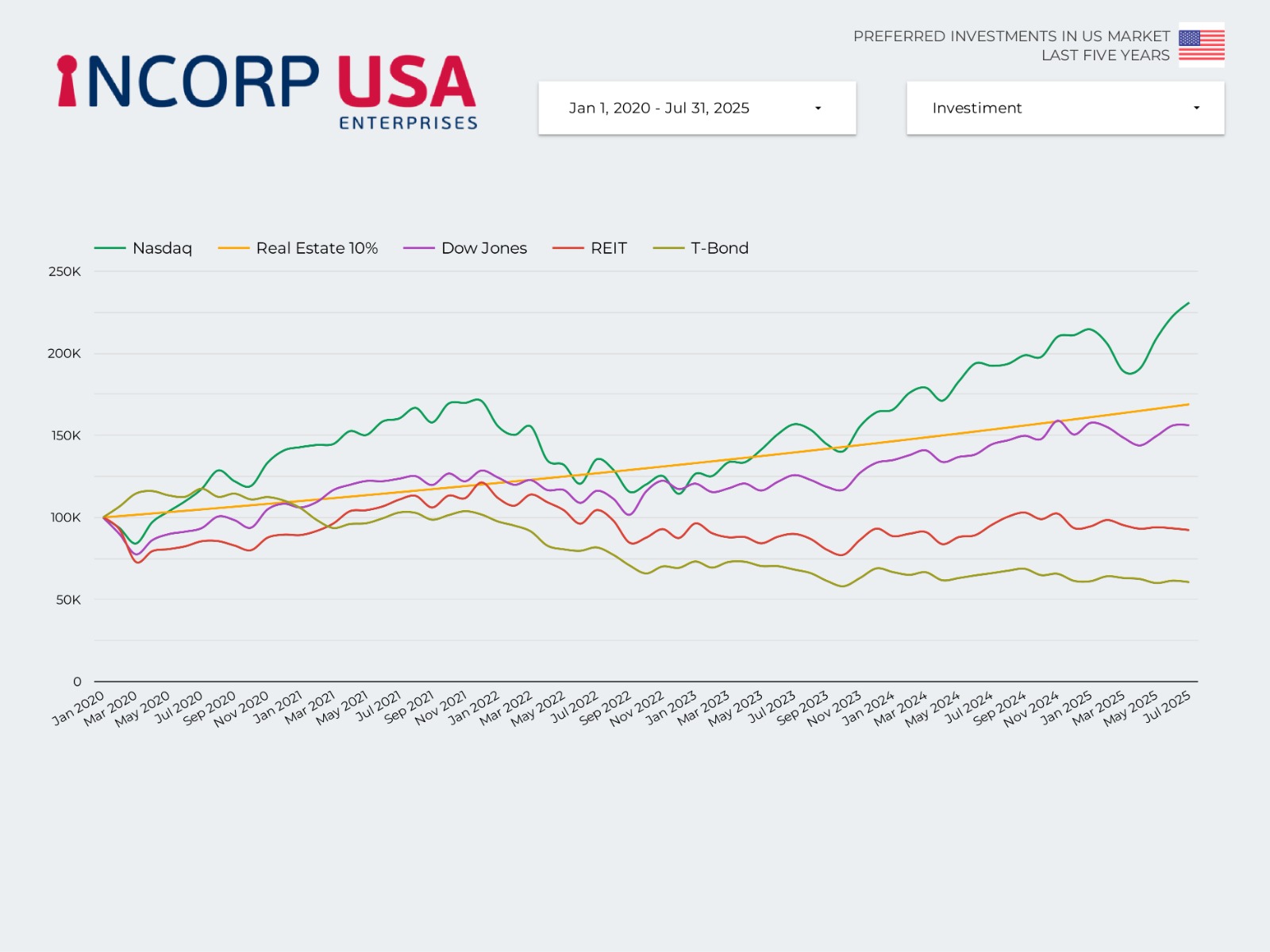
The chart illustrates the performance of various U.S. investment options between January 2020 and July 2025, including Treasury Bonds, REITs, the Dow Jones Industrial Average, the Nasdaq, and our exclusive Real Estate at 10% per year benchmark (in USD).
While the Nasdaq shows the strongest overall growth—driven largely by tech sector expansion — it is also the most volatile, with sharp downturns during crises such as mid-2022, when U.S. inflation surged, interest rates rose, corporate profits fell, and geopolitical tensions escalated due to the war in Ukraine.
Even in high-growth years like 2021 and 2023, the Nasdaq experienced significant corrections that could negatively impact portfolios. By contrast, real estate at a fixed 10% return offers stability and predictability, acting as a hedge against extreme stock market swings—ideal for conservative investors or those requiring predictable cash flow.
The Dow Jones, which includes industrial, financial, and consumer companies, shows more stable but slower growth compared to the Nasdaq, with smaller losses during downturns. REITs follow a similar trend to the Dow Jones but consistently underperform it, as they focus on steady dividend income rather than rapid capital appreciation.
Treasury Bonds remain the lowest-yielding investment in the comparison — safe, predictable, and virtually risk-free, but rarely exceeding 5 – 6% annually, even in strong economic periods.
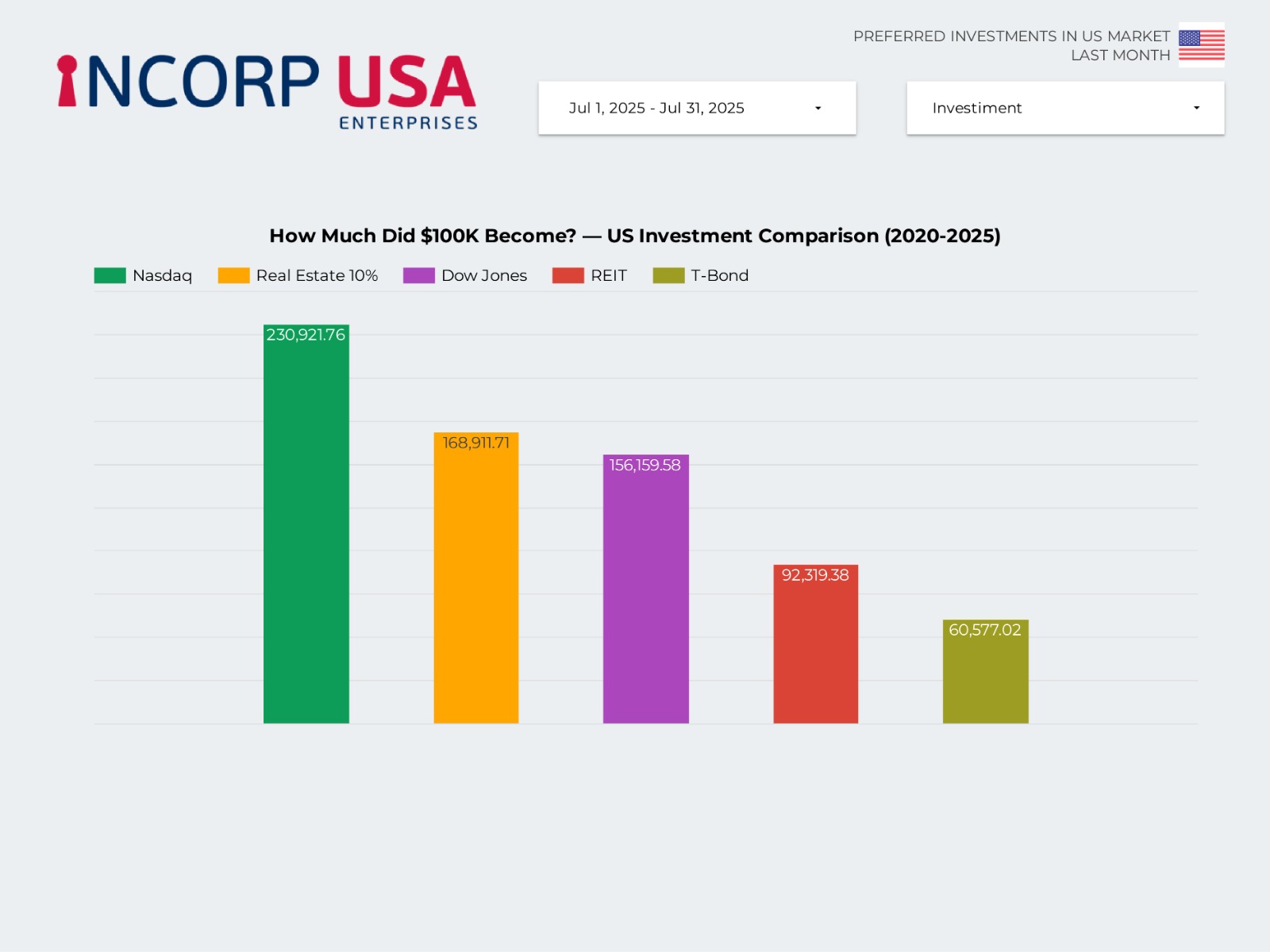
The chart above shows how an initial investment of $100,000 made in January 2020 would have grown by July 2025 if the amount had been kept in each of the options presented. The first column represents the Nasdaq, which would have reached around $222,683, leading the returns by a wide margin. Next, Real Estate with a 10% annual yield would have reached $167,575, followed by the Dow Jones at $156,035, REITs at $93,356, and finally the T-Bond at $61,512.
Despite the Nasdaq’s superior performance, it is important to remember that this index is associated with high volatility and elevated risk, with significant fluctuations throughout the period. In contrast, Real Estate at 10% per year stands out as the second-best performer but with considerably lower risk, in addition to the advantage of being a tangible physical asset that can be used, sold, or rented, and that tends to keep pace with real estate market appreciation.
When compared to the Dow Jones, REITs, and T-Bonds, Real Estate not only delivers above-average returns, but also offers inflation protection, passive income generation, and portfolio diversification. For these reasons, at Incorp we have chosen to direct our efforts and capital toward the real estate market, aiming to combine security, predictability, and consistent profitability in our projects.
What This Means for Real Estate Investors
Why Direct Real Estate Investment Can Outperform Other U.S. Assets
Even during stock market rallies, U.S. real estate remains a reliable wealth-building strategy — providing consistent income, asset appreciation, and protection against market volatility.
It’s worth noting that REITs are not the same as direct property ownership. While REITs are backed by real estate, they trade like stocks and are subject to daily market fluctuations. Physical properties, on the other hand, appreciate gradually and tangibly, providing both stable cash flow and long-term value growth.
Direct investment in U.S. real estate offers:
- Consistent annual returns (historically 10% with Incorp USA projects)
- Property value appreciation over time
- Capital gains upon sale
- Rental income potential
- Tax advantages unique to property ownership
This makes real estate an essential diversification tool, balancing portfolios that rely heavily on stocks or bonds with a tangible, income-producing asset.
Conclusion & Next Steps
How to Secure High-Yield Real Estate Investments in the U.S.
The data is clear: while high-growth assets like the Nasdaq can deliver substantial returns, they come with greater volatility and risk. U.S. real estate Investments — especially those structured to generate steady 10% annual yields — provide a safer, more predictable path to long-term financial growth.
At Incorp USA, we plan and manage every project with precision, delivering homes that combine strong profitability with enduring value.
Contact us today to receive our curated portfolio of U.S. real estate opportunities and discover how you can start building wealth through strategic property investments.
Stay Informed: Our research team updates this market analysis regularly. Subscribe to our newsletter to receive the latest insights directly in your inbox.